

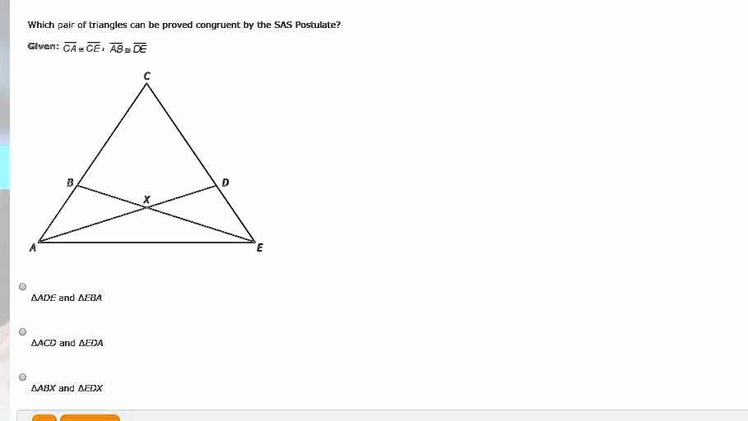
In the realm of geometry, proving the congruence of triangles is a fundamental concept that lays the groundwork for various geometric theorems and applications. Among the plethora of methods available, one powerful tool is the Side-Angle-Side (SAS) congruence criterion. This criterion asserts that if two triangles have two sides and the included angle equal, then the triangles are congruent. In this article, we delve into the intricacies of SAS and explore which pairs of triangles can be unequivocally proven congruent through this criterion.
Understanding SAS Congruence:
Before delving into specific examples, it’s essential to grasp the underlying principle of SAS congruence. The SAS criterion is based on the idea that if two triangles share the same length for two sides and the measure of the included angle between those sides, the triangles are congruent. Mathematically, if ΔABC and ΔDEF are triangles where AB = DE, AC = DF, and ∠A = ∠D, then ΔABC ≅ ΔDEF by SAS.
Examples of Congruent Triangles using SAS:
- Side-Angle-Side (SAS): Let’s consider two triangles, ΔABC and ΔPQR, where AB = PQ, BC = QR, and ∠B = ∠Q. According to the SAS congruence criterion, these triangles are congruent. This congruence can be proven by aligning the corresponding sides and angles, showcasing the equivalence.
- Applications in Real-world Scenarios: The SAS congruence criterion finds practical applications in fields such as architecture and engineering. For instance, consider a bridge with two supporting beams, each forming an isosceles triangle. If the lengths of the two equal sides and the included angle match, the stability and structural integrity of the bridge can be ensured, adhering to the SAS congruence criterion.
- Navigating Triangles in Navigation: SAS congruence plays a crucial role in navigation, where precise measurements are essential. Suppose a navigator needs to triangulate the position of a ship using bearings. If two triangles are formed with equal side lengths and included angles, the navigator can confidently determine the ship’s location, relying on the principles of SAS congruence.
Limitations and Considerations:
While SAS congruence is a robust criterion, it’s crucial to acknowledge its limitations. For instance, if the included angle is not shared between the two sides, the triangles cannot be proven congruent using SAS alone. Additionally, ambiguous cases may arise, leading to multiple possibilities for triangle congruence. Awareness of these nuances enhances the precision and accuracy of geometric proofs.
Conclusion:
In the vast landscape of geometry, the SAS congruence criterion stands out as a powerful tool for establishing triangle congruence. Through examples and real-world applications, we’ve explored the practical implications of SAS congruence and how it extends beyond the confines of mathematical theorems. Whether in the construction of bridges or the precision of navigation, understanding which pairs of triangles can be proven congruent by SAS opens up a world of possibilities in the realm of geometric reasoning. As we continue to unravel the mysteries of triangles and their congruence, SAS remains a steadfast and reliable criterion, guiding us through the complexities of spatial relationships.
